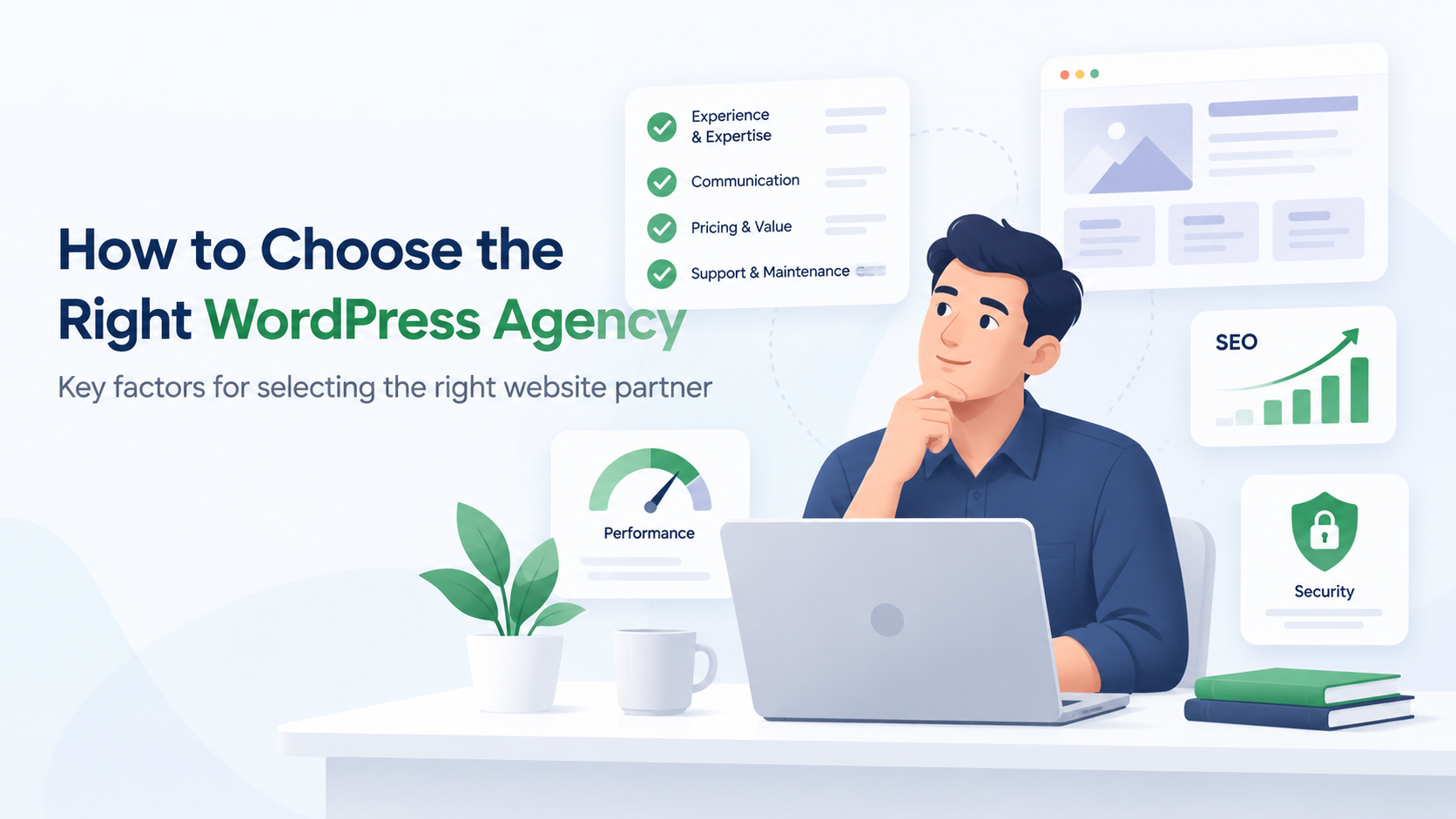
Choosing the right WordPress agency is one of the most important decisions you can make for your website.
A website is rarely just a collection of pages. It may be responsible for generating leads, selling products, publishing content, supporting customers, building authority, accepting bookings, delivering learning, or helping an organization communicate effectively with its audience.
That means the agency you choose should understand more than design. It should understand how WordPress development, performance, security, search visibility, content, infrastructure, analytics, and ongoing maintenance work together.
This guide explains what to look for when choosing a WordPress agency, which questions to ask before starting, and how to assess whether a provider can support your website effectively over the long term.
What Is a WordPress Agency?
A WordPress agency is a professional service provider that specializes in planning, building, improving, managing, and supporting websites created with WordPress.
Rather than focusing only on page design, a specialist WordPress agency can bring together multiple disciplines needed to operate an effective website. Depending on the project, these may include development, infrastructure, SEO, security, performance, content, WooCommerce, analytics, maintenance, and automation.
This specialization matters because WordPress has an extensive ecosystem of themes, plugins, hosting environments, databases, caching systems, security controls, integrations, and publishing tools.
Changes in one area can affect several others. For example, redesigning a website may influence its page speed, mobile usability, internal linking, search visibility, content structure, conversion paths, and long-term maintainability.
A specialist agency should therefore look at the website as a connected system rather than treating every requirement as an isolated technical task.
You can see how these capabilities fit together in our WordPress services directory.
Start With the Purpose of Your Website
Before comparing WordPress agencies, define what your website actually needs to accomplish.
Different websites require different approaches. A service business trying to generate qualified enquiries will have different priorities from an online store, publication, nonprofit organization, membership platform, or learning website.
Your website may need to:
- Generate leads and enquiries
- Sell physical or digital products
- Publish useful content
- Present professional services
- Build authority and credibility
- Accept appointments or bookings
- Support customers
- Deliver courses or educational resources
- Improve organic search visibility
- Support internal or external workflows
- Collect and analyze useful data
- Automate appropriate website processes
A good WordPress agency should ask about these objectives before recommending a technical solution.
The goal is not simply to build a website that looks attractive. The goal is to build or improve a website so that its structure, functionality, content, and technical foundation support the purpose for which it exists.
Look for Genuine WordPress Specialization
When comparing providers, determine whether WordPress is central to what they do or simply one item in a very broad list of unrelated services.
A specialist WordPress agency should understand the platform at several levels.
Themes and Website Structure
Themes, templates, block systems, page builders, reusable components, and custom layouts all affect how a website is built and how easily it can be maintained later.
Plugins and Functionality
WordPress plugins can add powerful features, but selecting too many or using poorly maintained plugins can introduce compatibility, security, or performance problems.
Hosting and Infrastructure
Hosting quality, DNS configuration, SSL, PHP compatibility, server resources, caching, backups, staging environments, and content delivery systems can all influence website reliability.
Search Visibility
SEO should be considered alongside content structure, technical configuration, internal linking, performance, and usability. Google’s SEO Starter Guide is a useful primary reference for understanding how websites can make content easier for search engines and users to understand.
Security
Security requires attention to software updates, user access, plugins, backups, hosting practices, configuration, monitoring, and recovery planning.
Performance
A website can look polished while still performing poorly because of oversized assets, unnecessary scripts, inefficient plugins, unsuitable hosting, or poor caching.
WooCommerce
Online stores introduce additional considerations such as products, checkout, customer accounts, payments, shipping, extensions, order management, security, and performance.
Evaluate the WordPress Services the Agency Provides
Not every WordPress agency offers the same capabilities. Review whether the agency can support both your immediate requirement and the connected areas that may influence the final result.
The advantage of broader WordPress capability is coordination. A performance problem, for example, may involve hosting, plugins, images, scripts, database behavior, or theme structure rather than one isolated issue.
Choose an Agency That Reviews Requirements Before Pricing
One of the strongest indicators of a professional process is whether the agency reviews your actual requirements before confirming the final scope and price.
WordPress projects can vary considerably. Two websites that appear similar to a visitor may require very different levels of work because of their technical foundations.
Factors that can affect scope include:
- The condition of the existing website
- Hosting environment
- Theme architecture
- Plugin dependencies
- Custom code
- Content volume
- Required integrations
- SEO history
- Performance issues
- Security concerns
- WooCommerce complexity
- Migration requirements
- Required functionality
- Delivery timeline
A requirements-first process allows the agency to understand the real work involved before defining the commercial terms.
You can see how this works in practice on our How It Works page.
Review How the Agency Communicates
Technical capability is important, but strong communication is equally important.
Before a Project starts, you should have a reasonable understanding of:
- What information the agency needs from you
- What work is included
- What is outside the agreed scope
- What the expected deliverables are
- The expected timeline
- What the price covers
- How updates will be communicated
- How reviews or revisions will be handled
- Which client inputs or access details are required
- What happens when new requirements arise
Good communication reduces misunderstandings and makes it easier for both parties to manage expectations.
A professional WordPress agency should also be able to translate technical issues into practical language. Clients should not need to become developers, server administrators, SEO specialists, and security experts just to understand what is happening with their website.
Look at How the Agency Approaches SEO
SEO is broader than adding keywords to pages. It includes the relationship between content, website structure, crawlability, internal linking, page experience, technical configuration, and search intent.
When reviewing a WordPress agency, look for an SEO approach that considers areas such as:
- Page titles and metadata
- Heading structure
- Site architecture
- Internal linking
- Indexation
- Canonical URLs
- Content quality
- Structured data where appropriate
- Mobile usability
- Performance
- Google Search Console
Google’s official SEO Starter Guide is a useful reference when evaluating claims made about search optimization.
For WordPress-specific search work, explore our WordPress SEO service.
Consider Website Performance From the Beginning
Performance should not be something addressed only after a website becomes slow.
Design and development decisions can have a direct impact on loading speed and responsiveness.
Common causes of poor performance include:
- Oversized images
- Too many plugins
- Heavy themes or page builders
- Unnecessary scripts
- Excessive animation
- Inefficient database behavior
- Weak hosting resources
- Poor caching configuration
- Too many third-party services
A visually attractive website can still create a poor experience if users spend too long waiting for it to load.
Performance also affects maintainability. The more unnecessary components a website contains, the more complex it can become to operate and troubleshoot.
If this is a priority for your website, review our Website Performance service.
Security Should Be Part of the Project
WordPress security should be considered during planning, development, and ongoing operation rather than treated as an optional extra after launch.
Website risks can increase when:
- WordPress core is outdated
- Plugins or themes are not maintained
- Unused software remains installed
- Weak passwords are used
- Administrator access is unnecessarily broad
- Backups are unavailable
- Plugins come from unreliable sources
- Hosting is poorly configured
- Login protection is inadequate
The official WordPress security hardening documentation is a useful external reference for understanding the layered nature of WordPress security.
You can also review our WordPress Security service for agency support.
Check Whether the Agency Understands WooCommerce
If your website sells products or services online, WooCommerce expertise deserves specific attention.
A WooCommerce website introduces operational considerations beyond standard page design, including:
- Products and variations
- Inventory
- Checkout
- Payments
- Shipping
- Taxes
- Orders
- Customer accounts
- Email notifications
- Extensions and integrations
- Store performance
- Security
The official WooCommerce documentation provides extensive guidance on store setup, administration, products, payments, orders, shipping, performance, and other operational areas.
If eCommerce is central to your website, evaluate whether the agency understands the operational side of WooCommerce as well as the visual design.
Explore our WooCommerce service if you need support building or improving a WordPress store.
Ask About Analytics and Measurement
A website should ideally provide useful information about what happens after visitors arrive.
Analytics can help answer questions such as:
- Where are visitors coming from?
- Which pages receive the most traffic?
- Which content attracts search visitors?
- Are people submitting forms?
- Are visitors abandoning important pages?
- Which campaigns are producing useful traffic?
- Are organic visits improving?
- Which pages may need further optimization?
Measurement allows a website to improve over time rather than remaining static after launch.
Google’s Search Console is one important tool website owners can use when assessing visibility and performance in Google Search.
Look for a Clear Project Management Process
A professional agency should have a defined method for taking a requirement from initial submission to completed delivery.
The process does not need to be complicated. It needs to be understandable.
A typical workflow may include:
- Requirement submission
- Review and clarification
- Scope definition
- Pricing and timeline confirmation
- Implementation
- Client review
- Adjustments within the agreed scope
- Completion and handover
At every stage, both parties should understand what is happening and what is expected next.
Find Out Who Is Responsible for Delivery
Different WordPress service providers use different delivery models.
Some platforms require clients to identify, compare, hire, and manage individual freelancers themselves.
An agency-managed model works differently. The agency coordinates the relevant expertise according to the requirements of the Project.
For example, one website improvement Project could require:
- Design
- Development
- SEO
- Performance optimization
- Content implementation
- Analytics configuration
The client should not necessarily need to identify and manage several separate specialists.
Coordinated delivery can simplify communication and reduce fragmentation when multiple WordPress capabilities need to work together.
Evaluate Whether the Agency Supports Existing Websites
Not every WordPress Project starts with a blank website.
Many website owners need to improve something that already exists.
Common requirements include:
- Outdated design
- Poor mobile experience
- Slow page loading
- Weak organic visibility
- Broken functionality
- Plugin conflicts
- Security concerns
- Poor navigation
- Low conversion performance
- WooCommerce problems
- Difficult content management
- Hosting or infrastructure issues
A capable agency should be able to assess what needs improvement without assuming that everything must be rebuilt.
When technical problems are involved, our Maintenance & Troubleshooting service provides another route for targeted support.
Ask About Maintenance After Launch
A WordPress website continues changing after launch.
WordPress core, themes, plugins, hosting environments, search algorithms, security risks, content, and business requirements can all change over time.
Ongoing website needs may include:
- Updates
- Backups
- Security monitoring
- Performance reviews
- SEO improvements
- Content publishing
- Troubleshooting
- Compatibility fixes
- New functionality
- WooCommerce improvements
If your website is important to your operations, ask what options are available after the initial Project is completed.
Review the Agency’s Content and Documentation
The quality of an agency’s educational and support content can provide useful insight into how clearly it communicates.
Review resources such as:
- Service pages
- Help articles
- Frequently asked questions
- Blog posts
- Support documentation
- Guides
Clear documentation can make it easier for clients to understand services, Projects, account functions, support processes, and technical decisions.
Esposearch.net maintains a dedicated Help Center for guidance, support information, frequently asked questions, and client resources.
Questions to Ask Before Hiring a WordPress Agency
Asking practical questions before starting can reveal a great deal about how an agency works.
What WordPress services do you specialize in?
This helps determine whether the agency’s capabilities match the technical and commercial requirements of your website.
How do you determine the Project scope?
A good answer should involve understanding your website, objectives, requirements, dependencies, and expected deliverables before the final scope is confirmed.
How is pricing determined?
You should understand how complexity, scope, deliverables, integrations, timeline, and other requirements influence the price.
What information will you need from me?
Depending on the Project, the agency may need your website URL, WordPress access, hosting details, content, objectives, reference materials, integration information, or other technical inputs.
Who manages the work?
Find out whether you work with the agency as one coordinated provider or whether you will need to manage several separate individuals.
How will progress be communicated?
Understand when updates are provided, how questions are handled, and how the review process works.
What happens when additional requirements arise?
Websites evolve during Projects. There should be a clear process for assessing work that falls outside the original agreed scope.
What happens after delivery?
Ask about handover, maintenance, troubleshooting, documentation, and options for future improvements.
Red Flags to Watch For
No single warning sign automatically determines whether a provider is unsuitable, but several patterns deserve closer examination.
Promises of Guaranteed Search Rankings
SEO outcomes depend on many factors beyond the control of a single agency. Be cautious when marketing claims sound unrealistically certain.
No Requirements Review
If a provider proposes a detailed solution without first understanding your website or objectives, the recommendation may not reflect the actual problem.
Unclear Scope
You should know what is being delivered and what responsibilities belong to each party.
Unnecessary Technical Complexity
More plugins, tools, scripts, and integrations do not automatically create a better website. Every additional dependency should serve a clear purpose.
No Backup or Recovery Consideration
Websites can experience failed updates, security incidents, hosting problems, configuration errors, or accidental changes. Recovery planning matters.
Performance Is Ignored
A visually attractive website can still perform poorly if technical efficiency is not considered during development.
Poor Communication
If requirements, responsibilities, timelines, and deliverables remain unclear before work begins, misunderstandings may become more difficult once the Project is underway.
Should You Hire a Freelancer or a WordPress Agency?
Both models can be appropriate depending on the requirement.
A freelancer can be a practical choice for a focused piece of work such as a small code change, content update, specific bug fix, or other narrowly defined requirement.
An agency may be more appropriate when:
- The Project involves several WordPress capabilities
- Work needs to be coordinated across different technical areas
- The website is important to business or organizational operations
- You need an accountable agency relationship
- Long-term website support matters
- You prefer not to manage several separate service providers
The key question is not whether agencies are universally better than freelancers. It is whether the delivery model matches the complexity and coordination requirements of your particular website.
How Esposearch.net Approaches WordPress Projects
Esposearch.net is a Specialist WordPress Agency helping clients build, improve, manage, optimize, and grow WordPress websites around their actual requirements.
Professional WordPress services are delivered through custom Projects.
Instead of asking clients to choose from rigid predefined packages, we begin with the actual requirement and review what needs to be accomplished.
Relevant expertise is coordinated internally according to the requirements of the Project. The client works with us as the agency rather than having to identify and manage individual specialists.
If you want to understand the workflow in more detail, read How It Works.
You can also explore our WordPress services to see the capabilities available for new and existing websites.
If you already know what your website needs, you can Start Your Project. If you are still defining the requirement, contact us to discuss your requirements.
Final Checklist for Choosing a WordPress Agency
Before making your decision, use this checklist to evaluate the provider you are considering.
Final Thoughts
Choosing the right WordPress agency should not be reduced to comparing prices, portfolios, or website designs.
A more useful question is:
Can this agency understand what my website needs to achieve and coordinate the right WordPress capabilities to make that happen?
A strong WordPress agency should combine technical understanding, clear communication, appropriate scoping, structured delivery, and support for the website’s longer-term needs.
It should help you make better decisions about your website rather than simply execute isolated instructions.
For website owners who depend on WordPress for marketing, sales, publishing, customer service, education, or operations, that distinction matters.